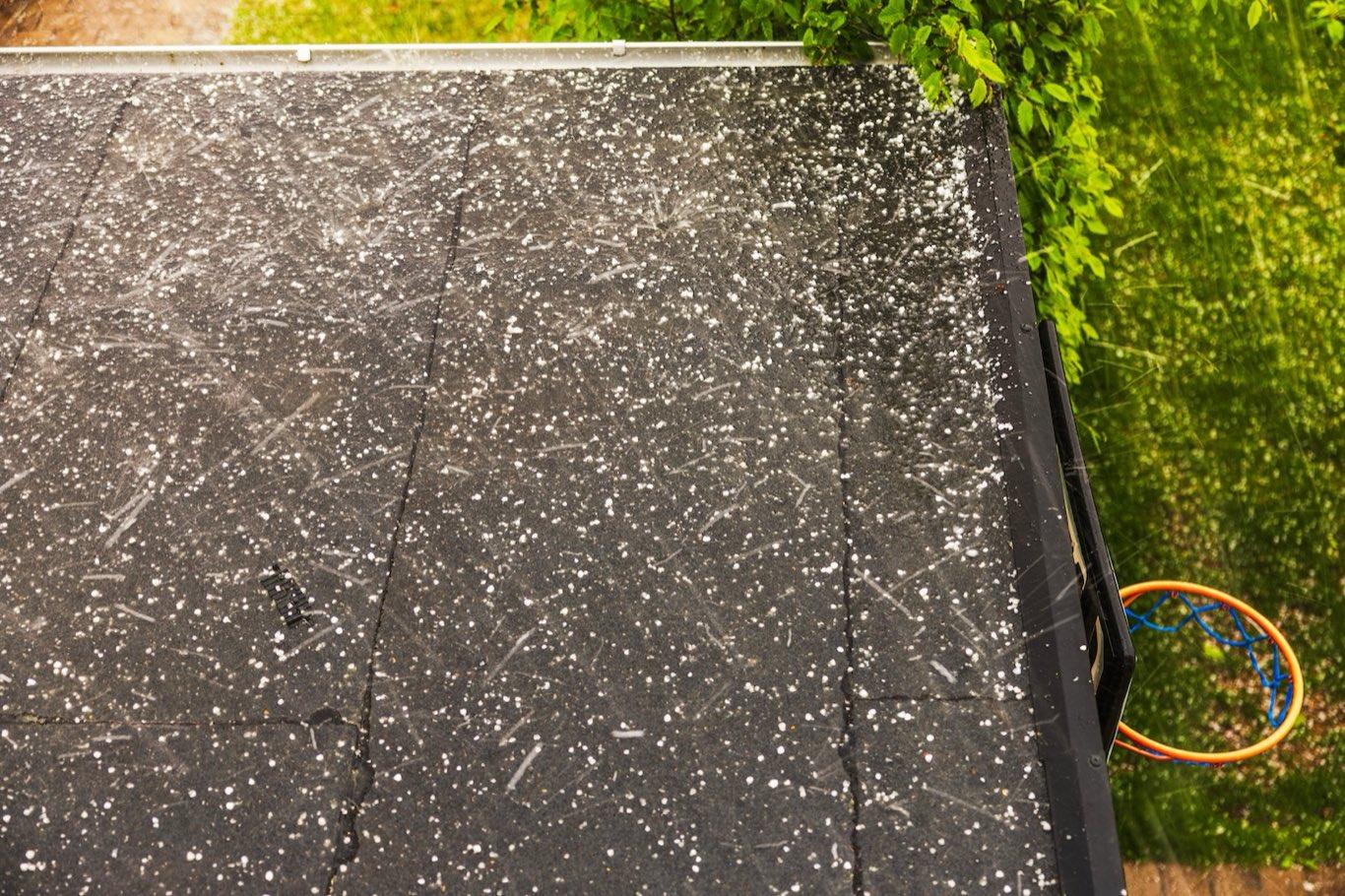
If you are looking at a dented gutter and a yard full of bruised shingles, the first question is usually about money. The average payout for hail damage on a homeowners claim is about $14,747, based on five years of industry loss data from the Insurance Information Institute. Treat that as a benchmark, not a promise. Your check could land at a few thousand dollars or climb well into five figures, because a hail payout is built from your specific roof, your deductible, and how your insurer decides to value the loss.
Here is what actually goes into that number, for homes and for commercial property alike.
Why a single average can mislead you
An average blends very different claims into one figure. A handful of cracked siding panels and one cosmetic roof vent sit in the same dataset as a full tear-off and replacement on a 3,000 square foot roof. So the "average" is real, but almost nobody gets exactly the average.
A more honest way to think about it: minor hail bruising that does not breach the roof surface often pays a few thousand dollars or gets absorbed by the deductible. A partial repair runs higher. A full roof replacement on a larger or steeper home, with gutters, screens, and exterior paint, is where claims pass $20,000. Your number depends on the size and pitch of the roof, the material, and how much of it the adjuster agrees was actually damaged.
What the loss data shows
The big picture is well documented. Wind and hail together make up the most common homeowners insurance claim in the country. Over 2019 through 2023, about 2.8 percent of insured homes filed a wind or hail claim each year, the largest share of any cause, and the average wind and hail claim came to $14,747, according to the Insurance Information Institute. That figure groups wind with hail, and hail is the heavy hitter behind most severe-storm roof losses.
The dollars at stake are enormous. State Farm alone paid more than $3.5 billion in hail claims in 2022, a jump of over $1 billion from the year before, driven by more storms and higher repair costs. Hail keeps coming, too. NOAA's Storm Prediction Center logged 5,432 major hail events in 2025, with Texas and Kansas leading the country, per the Triple-I hail facts page. The point for you is simple: insurers see a lot of hail, they track it closely, and they scrutinize roof claims.
What actually decides your hail payout
Four things move your number more than anything else.
How the loss is valued is first. Replacement cost value, or RCV, pays what it costs to replace the roof with similar materials today, with no age deducted. Actual cash value, or ACV, pays that replacement cost minus depreciation for the age and wear of the roof. The NAIC explains the difference, and on an older roof it is the difference between a full payout and a fraction of one. Many insurers now write ACV or scheduled roof coverage on roofs past a certain age, so check your declarations page before you assume.
Your deductible comes off the top. In hail-prone states, a lot of policies carry a separate wind and hail deductible set as a percentage of the home's insured value, often 1 to 5 percent, instead of a flat dollar amount. On a home insured for $400,000, a 2 percent deductible is $8,000 out of your pocket before the policy pays a cent. We break this down in do you pay a deductible for hail damage.
Scope is third, and it is where most money is won or lost. The adjuster decides how much of the roof was damaged, whether it can be repaired or must be replaced, and whether matching laws or shingle discontinuation force a full replacement. Test squares, soft metals like gutters and vents, and the date of the storm all factor in.
The recoverable depreciation is the piece people forget. On an RCV policy you usually get two checks. The first is the ACV amount up front. The second, the held-back depreciation, is released after you complete the repair and send the final invoice and proof of payment. Skip the paperwork and you leave that second check on the table.
Residential, commercial, and business property
The same mechanics apply to commercial and business property, with bigger numbers. Commercial roofs are larger and often flat, so a single hailstorm can damage membrane, HVAC units, skylights, and rooftop equipment all at once, pushing payouts far above a typical home. If hail damage forces you to close or scale back operations, a commercial policy may also cover lost income through business interruption coverage, but only when the shutdown traces to a covered loss. For owners, the roof check is sometimes the smaller half of the claim.
How to protect the size of your check
Document before you clean up or let a crew on the roof. Date-stamped photos of dented soft metals, collected shingle granules, and the storm date give you proof the damage is recent and hail-related. Get your own written estimate from a reputable roofer instead of relying solely on the insurer's number. If the first offer feels thin, it often is, and the gap between an insurer's initial estimate and a fully documented one can be thousands of dollars. For the full walkthrough, see how hail damage insurance claims work, and if you are weighing whether to file at all, is it worth making an insurance claim for hail damage lays out the trade-offs, including whether the claim raises your rate.
When the payout comes in low
A low offer is not the final word. You can dispute it in writing, invoke the appraisal clause in your policy when the fight is purely about the dollar amount, or bring in a licensed professional to rebuild the claim. If you were denied outright, how to handle a denied insurance claim covers your next moves, and can you claim compensation for property damage explains how property payouts are calculated start to finish.
A public adjuster is a licensed professional who works for you, not the insurance company. At Clayem, our licensed adjusters read your policy, document the hail damage the way the carrier needs to see it, and negotiate for the full amount you are owed. You can see how we work with property owners or start your claim and have a licensed adjuster review it. We work on contingency, so if we do not beat the insurer's original offer, you owe nothing.
Hail payouts are not fixed. The roof you start with sets the ceiling, but documentation and a careful read of your policy decide how close you get to it.