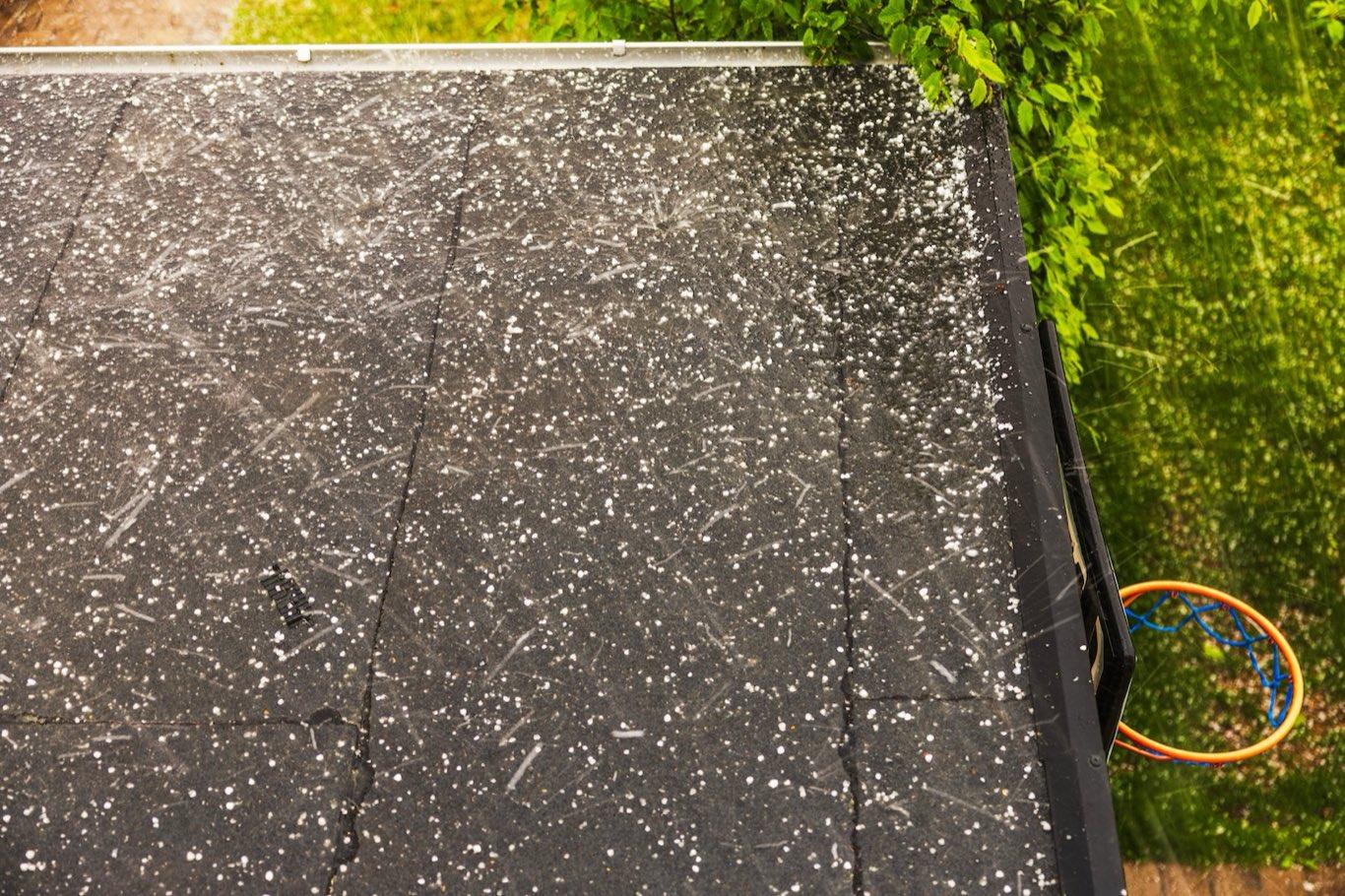
A hailstorm leaves your roof dented and your gutters full of shingle grit, and before you call your insurer one practical question comes up: do you pay a deductible for hail damage? The short answer is yes. Hail is a covered cause of loss on almost every standard property policy, but covered does not mean free. You pay your deductible first, and the policy covers the rest of the repair. What surprises most owners is how that deductible is calculated, because for hail it is often not a flat dollar amount.
Here is how a hail damage deductible actually works, for homes and for commercial buildings, and how to find yours before you file.
Yes, you pay a deductible, and there may be more than one
Every property claim runs through a deductible. It is the amount you cover out of pocket before your insurer pays anything. For a kitchen fire or a theft, that is usually a flat figure, often $500, $1,000, or $2,500, set on your policy.
Hail is where it gets different. Many policies carry a separate deductible just for wind and hail, and it is frequently larger than your standard deductible. So the deductible that applies to a hailstorm may not be the same one that applies to the rest of your policy. The first step is knowing which deductible your claim falls under.
The two ways a hail deductible is calculated
A wind and hail deductible comes in one of two forms.
The first is a flat dollar amount, the same kind of number you see on the rest of your policy. If your wind and hail deductible is $2,000, you pay the first $2,000 of a covered hail repair and the insurer pays the rest.
The second, and the more common one in hail-prone areas, is a percentage. Instead of a fixed dollar figure, the deductible is a percentage of your home's insured value, usually 1 to 5 percent of your dwelling coverage. According to the Insurance Information Institute, this percentage is based on the home's insured value, not on the size of the repair, which is what catches people off guard.
How a percentage hail deductible adds up
The math is simple once you see it, and the number can be large. Take a home insured for $300,000 with a 2 percent wind and hail deductible. Two percent of $300,000 is $6,000, so you cover the first $6,000 of a hail repair yourself before the policy pays a dollar. Push that to a 5 percent deductible and you are responsible for $15,000 on the same home.
Compare that to a flat $1,000 deductible and you can see why the percentage matters so much. The III notes that in some higher-risk regions a percentage deductible is not optional, while in other areas you may be able to pay a higher premium to keep a traditional dollar deductible. The III also explains the same structure in its background on hurricane and windstorm deductibles, since wind, hail, and hurricane deductibles all work off the insured value the same way.
Where you are most likely to see a separate hail deductible
Separate wind and hail deductibles are most common in states that get severe storms and hail on a regular basis, including the central plains around Tornado Alley and parts of the Midwest. If you live in Texas, Oklahoma, Kansas, Nebraska, Colorado, or a similar hail belt, there is a good chance your policy carries one. Insurers added these deductibles as storm losses climbed, as a way to share more of the repair cost with the policyholder.
Your location does not just affect whether you have the deductible. It can also affect whether the percentage version is mandatory or whether you can buy your way back to a flat dollar figure.
The deductible is not always your only out of pocket cost
There is a second number worth understanding before you file. Many policies pay roof claims on a replacement cost basis, which means they first pay the depreciated value of the roof, then release the held-back depreciation after the work is done and invoiced. You front that gap along with your deductible until the final payment comes through.
Some policies, especially on older roofs, settle hail damage on an actual cash value basis instead, which factors in the roof's age and wear and pays less than full replacement. If your roof is old, read this part of your policy closely, because it changes the real cost of a hail loss more than the deductible alone. We walk through the full settlement process in how hail damage insurance claims work.
One deductible per claim, not per item
A common worry is that the deductible applies to every damaged item separately. It does not. The deductible applies once per claim. A single hailstorm that damages your roof, your siding, your gutters, and an air conditioner condenser is one claim with one deductible, even though several parts of the property were hit. That works in your favor, because it means the deductible is a single threshold for the whole storm, not a repeated charge.
Hail deductibles on commercial and business property
Commercial property policies follow the same logic, often with larger numbers. A business policy on a warehouse, retail center, or office building commonly carries a separate wind and hail deductible, and in storm-prone regions it is frequently a percentage of the insured building value. On a building insured for several million dollars, even a 1 or 2 percent hail deductible is a significant figure, so it belongs in your planning before a storm, not after.
Businesses also have an exposure homeowners do not. If hail damage forces you to close while the roof is repaired, business income coverage can replace lost revenue during the shutdown, subject to its own terms and waiting period. That is part of the picture when you weigh whether a hail claim is worth filing.
How to find your hail deductible and decide whether to file
Pull out your declarations page, the summary at the front of your policy. It lists your deductibles, and if you have a separate wind and hail deductible it will be spelled out there, either as a dollar amount or as a percentage of your dwelling coverage. If it is a percentage, do the multiplication now so the number does not surprise you later.
Then compare that figure to the likely cost of the repair. If a minor hail event barely exceeds your deductible, filing may not be worth it, and a claim can affect your future rate, which we cover in does home insurance go up after a hail claim. If the damage is serious, filing usually makes sense, because a full roof replacement costs far more than the deductible.
One more point. The adjuster who inspects your roof works for the insurance company, and the deductible is theirs to apply. If the damage is significant or the first offer feels low, it helps to have someone on your side, which we explain in who can help you with insurance claims.
Clayem is a licensed public adjusting service that represents you, the policyholder, on residential and commercial hail claims. We review your policy, confirm which deductible actually applies, document the damage, and negotiate with your insurer on contingency, so you only pay if we recover more than the original offer. Start your claim and a licensed adjuster will take a look.