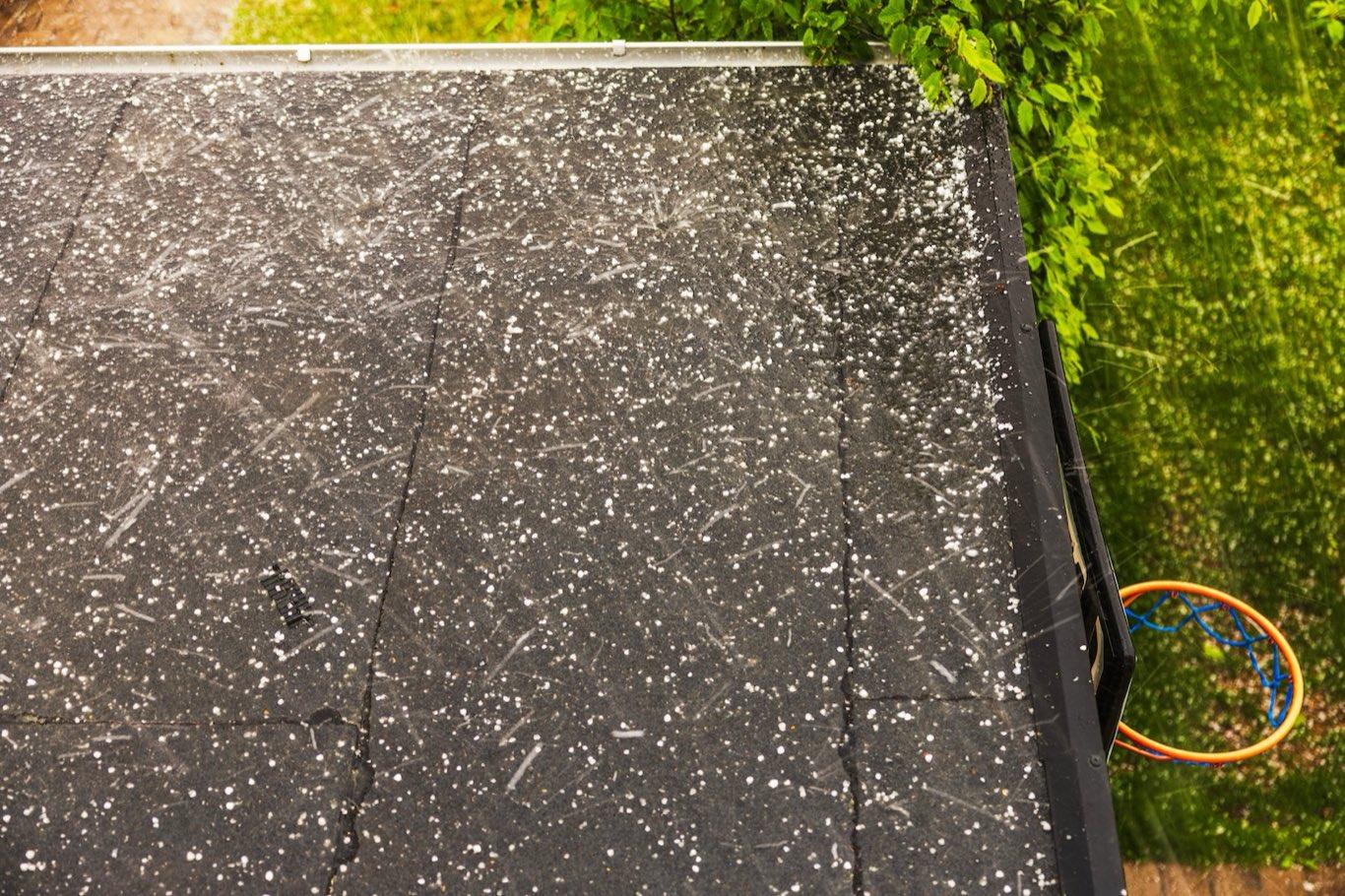
A hailstorm passes in a few minutes and leaves you with dented gutters, bruised shingles, and a roof you cannot fully see from the ground. Then comes the harder part. A hail damage insurance claim has its own rules, its own deductible, and its own math for deciding how much you actually get paid. Knowing how that process works before you file puts you in a much stronger position when the adjuster shows up.
Here is how a hail damage claim moves from the storm to the check, for both homes and commercial buildings.
Is hail damage covered by insurance?
In most cases, yes. Hail is a sudden, accidental event, which is exactly the kind of loss property insurance is built for. A standard homeowners policy, usually written on what insurers call special form coverage, treats wind and hail as covered perils. Most commercial property policies do the same.
Wind and hail are also among the most common and most expensive property claims in the country. The Insurance Information Institute tracks claims data year after year, and wind and hail losses regularly sit near the top of the list for homeowners. So if your roof took a beating, you are far from alone, and the coverage is usually there.
The catch is the fine print. Some policies in hail-prone regions exclude or limit cosmetic damage, and an older roof that was already failing can complicate a claim. Reading your own declarations page is the first step.
Your deductible comes out first
Before the insurer pays a dollar, your deductible applies. With hail, that number is often larger than people expect, because many policies use a separate wind and hail deductible.
A regular deductible is a flat amount, say $1,000. A wind and hail deductible is usually a percentage of your insured value instead, commonly 1 to 5 percent. On a home insured for $300,000 with a 2 percent wind and hail deductible, you are responsible for the first $6,000 of the repair. On a commercial building insured for $1 million with the same percentage, that is $20,000 out of pocket before coverage kicks in.
Check which type you have. It changes the entire calculation of whether a claim is worth filing, and it is the single most common surprise in hail claims.
ACV versus replacement cost: how the math works
How much the insurer pays depends on whether your policy is written for actual cash value (ACV) or replacement cost value (RCV). This is where a lot of payouts get smaller than homeowners expect.
Actual cash value pays what the damaged property is worth today, after subtracting depreciation for age and wear. A ten year old asphalt roof has already used much of its life, so an ACV settlement reflects that lost value and leaves you to cover the gap.
Replacement cost value pays what it costs to replace the roof with similar new materials, without the depreciation penalty, once you have met your deductible. There is a wrinkle worth knowing: with an RCV policy, insurers often pay in two parts. You get the actual cash value first, and the held back amount, called recoverable depreciation, is released after the work is finished and you submit the final invoice. United Policyholders, a nonprofit consumer group, explains this split in more detail. If you never complete the repairs, you may never collect that second check.
What the claim process looks like
Most hail claims follow the same path:
- Document the damage. Take dated photos of the roof, siding, gutters, windows, and any interior leaks. Keep them.
- Prevent further damage. You have a duty under most policies to protect the property from getting worse, such as tarping a roof, and you can keep receipts for those temporary repairs.
- Report the loss promptly. Policies require timely notice, and many also set a deadline to file a sworn proof of loss and a separate time limit to file suit, often one to two years.
- Meet the adjuster. The insurer sends an adjuster to inspect. On roofs, they typically chalk off a ten by ten foot test square on each slope and count the hail hits to decide whether a slope qualifies for repair or full replacement.
- Review the estimate, then negotiate. The first offer is a starting point, not a final word. You can dispute it and submit supplements for damage the adjuster missed.
The adjuster who inspects your home works for the insurance company, not for you. They are often fair, but their job is to settle the claim for the carrier. We cover that distinction in more depth in who can help you with insurance claims.
Hail claims on commercial and business property
For a business, hail can do more than damage the building. A torn roof or shattered skylight can force you to close while repairs happen, and that lost income is its own problem.
Commercial property policies usually cover hail under special form coverage, often with the same kind of percentage wind and hail deductible, sometimes a larger one. If the damage shuts you down, business income coverage, also called business interruption, can reimburse lost revenue during the repair period. These coverages generally require direct physical damage to your property and impose a short waiting period, often 24 to 72 hours, before the income benefit starts. Read your policy so you know what triggers it.
When the first offer feels low
Hail claims are some of the most disputed property claims, partly because of the depreciation math and partly because roof damage is genuinely hard to assess. If your settlement does not seem to match the real cost of repair, you have options.
You can ask the adjuster to re-inspect, get an independent estimate from a reputable contractor, or bring in a licensed public adjuster who works for you instead of the insurer. A public adjuster reads your policy, documents the loss, and negotiates the claim on your behalf, usually for a percentage of what they recover. We weigh the trade-offs in is using a public adjuster a good idea. If your claim was flat out denied, start with how to handle a denied insurance claim.
Clayem is a licensed public adjusting service that represents you, the policyholder, on residential and commercial hail claims. We review your policy, document the damage, and negotiate with your insurer on contingency, so you only pay if we recover more than the original offer. Start your claim and a licensed adjuster will take a look.